
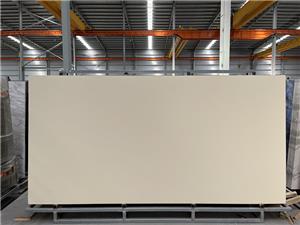
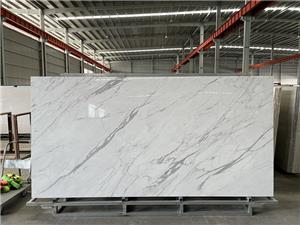
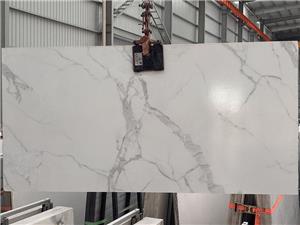
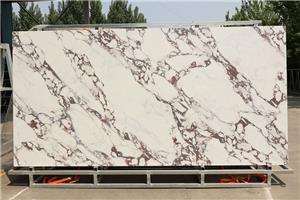
How Large Can Sintered Stone Slabs Be
Sintered stone is available in large slab formats designed to create expansive surfaces with fewer joints. But there is no single maximum slab size that applies to every sintered stone product.
Available dimensions depend on the manufacturer, production capabilities, collection, thickness, surface finish and product specification. For a project buyer, therefore, the more useful question is not simply how large a sintered stone slab can be manufactured, but whether the available slab format is suitable for the finished surfaces, fabrication process and installation conditions.
Understanding the relationship between slab dimensions and the rest of the project can help architects, designers, fabricators and purchasing teams make better decisions before material is ordered.
Sintered Stone Slab Size Depends on the Product and Manufacturer
Large-format sintered stone is produced in a range of dimensions rather than one universal standard.
Manufacturing equipment, pressing technology, kiln capacity and individual product specifications can all influence the formats a manufacturer can produce. Different collections from the same supplier may also have different available dimensions.
Thickness can be another consideration. A manufacturer may offer several thicknesses within a product range, but that does not necessarily mean every thickness is available in every slab size.
Surface finish, design and production requirements can also affect available formats. A particular decorative collection may have different production specifications from a plain-color surface, even when both belong to the same broader sintered stone range.
For this reason, buyers should work from the actual slab dimensions available for the selected product, rather than assuming that a dimension offered by one manufacturer will automatically be available from another.
This distinction becomes especially important when a project has been designed around unusually large finished pieces.
What Slab Dimensions Actually Mean for a Project
The nominal dimensions of a slab are only the starting point.
A finished countertop, wall panel, tabletop or architectural component rarely uses the entire slab without modification. The usable material depends on the dimensions and arrangement of the required pieces, as well as cutouts, edge treatments and the positioning of the finished surfaces.
This means that a large slab does not automatically produce a large finished piece.
For example, a slab may have enough overall area for a long countertop but still require careful planning because the desired finished dimensions, sink opening, cooktop cutout or edge treatment affect how the piece can be produced.
The same principle applies to wall panels and furniture. The question is not only whether the slab is large enough in total, but whether its dimensions accommodate the required finished components in an efficient layout.
For commercial projects, this distinction can influence both material planning and procurement decisions.
Large Slabs Create More Design Freedom
The main design advantage of a large slab is continuity.
When a large surface can be produced from a single piece or with fewer joints, the finished design can appear more continuous. This can be particularly valuable for expansive countertops, kitchen islands, feature walls, reception desks, furniture surfaces and other architectural elements.
Large formats can also make the visual characteristics of the material easier to appreciate across a broad surface.
For marble-inspired sintered stone, for example, a larger uninterrupted area can allow veining and movement to extend across the design with fewer interruptions. The effect depends on the specific collection and how the slab is cut, but slab dimensions can become part of the visual planning process rather than simply a manufacturing specification.
This is one reason large-format sintered stone has become increasingly relevant to contemporary architectural and interior projects.
The benefit, however, needs to be considered alongside the practical requirements created by the larger piece.
Slab Dimensions Influence Material Yield
A larger slab can provide more freedom when arranging finished pieces, but size alone does not determine material efficiency.
Yield depends on how the required components fit within the available slab format.
A project may require several different finished dimensions, each with its own cutting orientation and edge requirements. Openings and irregular shapes can further affect the usable layout.
Consequently, the most efficient slab is not necessarily the slab with the greatest total area.
The relationship between available slab dimensions and the dimensions of the finished components is what matters.
This is particularly important when multiple surfaces are being produced from the same material. A suitable slab format can make it easier to organize the required pieces, while an unsuitable format may result in more leftover material even when the total slab area appears sufficient.
For projects where detailed yield optimization is required, slab dimensions should be analyzed together with the complete cutting plan rather than considered in isolation.
Large Formats Create Additional Fabrication Requirements
Increasing slab dimensions can change the practical demands placed on fabrication.
A larger slab requires sufficient working space, appropriate support and equipment capable of handling its dimensions. The fabrication environment therefore becomes an important consideration before large-format material is ordered.
The issue is not simply whether a fabricator can cut the material. The complete process needs to accommodate the slab from handling and positioning through processing and preparation of the finished component.
Large finished pieces can also require greater attention to movement within the fabrication facility. Storage areas, work surfaces and access routes may need to accommodate the material before and after processing.
These considerations do not mean that large slabs are difficult to fabricate. They mean that slab size should be coordinated with the fabricator's capabilities before the project reaches production.
Detailed cutting and fabrication methods for large-format sintered stone are a separate technical subject. Here, the important point is that the available slab format needs to match the production environment.
Transportation and Handling Become Part of the Specification
Once slabs become larger, logistics become part of the material decision.
A slab that can be manufactured may not automatically be convenient to move through every stage of a project. Weight, packaging, loading equipment, storage arrangements and transportation conditions all become more relevant as dimensions increase.
The route from factory to installation site should therefore be considered before confirming an unusually large format.
For international projects, this can include container loading and unloading arrangements. At the distribution or fabrication facility, the available equipment and storage area also need to accommodate the selected dimensions.
The same consideration continues at the construction site.
Large finished components may require suitable lifting equipment, adequate personnel and a planned installation sequence. These requirements are not reasons to avoid large-format sintered stone; they are reasons to coordinate the material specification with the project's logistics.
For professional buyers, this is an important distinction. The largest available slab is only useful when the entire supply and handling chain can accommodate it.
Site Access Can Limit the Practical Size of Finished Pieces
The final installation environment can place a practical limit on finished-piece dimensions even when the material itself is available in a much larger format.
Doors, elevators, corridors, stairways and other access points may determine how large a fabricated component can actually be moved into position.
This is particularly important for commercial interiors, high-rise buildings and renovation projects where access routes may already be constrained.
A large slab may therefore be suitable for fabrication but unsuitable as one uninterrupted finished piece if the finished component cannot reach its destination.
Site access should be reviewed alongside the planned finished dimensions before fabrication begins.
This can influence whether a project uses one large component, several smaller components or a different layout altogether.
How Buyers Should Plan Around Available Slab Formats
For a project using large-format sintered stone, planning should begin with the finished surfaces rather than simply selecting the largest slab available.
The required countertop, wall panel, furniture component or architectural surface should first be defined in terms of finished dimensions and design intent.
Those requirements can then be compared with the actual slab formats available for the selected sintered stone product.
The next step is to consider how the finished components can be arranged within those slabs. At this stage, fabrication capabilities and edge requirements become relevant, followed by transportation and site access.
This sequence helps prevent a common procurement problem: choosing a slab format because it looks suitable on a product specification sheet without checking whether the finished material can be fabricated, transported and installed efficiently.
For commercial projects, early coordination between the material supplier, fabricator, designer and installation team can be particularly valuable. It allows slab dimensions to be considered before the design becomes difficult or expensive to change.
The goal is not to maximize slab size at all costs. It is to select a format that works with the finished dimensions, design layout, fabrication capabilities and logistics of the project.
Large Slab Size Is a Project Specification, Not Just a Product Feature
Sintered stone can be manufactured in large slab formats, but there is no universal maximum dimension that applies to every product.
The available size depends on the manufacturer and product specification, while the practical size of a finished component depends on much more than the slab itself.
Large formats can provide greater design continuity and fewer joints, but they also affect material layout, fabrication, transportation and installation planning.
For architects, designers, fabricators and purchasing teams, the most useful approach is therefore to start with the required finished surfaces and work backward to the appropriate slab format.
A large slab is valuable when its dimensions support the design and production process. The best format is not necessarily the largest one available, but the one that can move efficiently from factory to fabrication to final installation.