
Sintered Stone Slab Thickness Guide: 6mm vs 12mm vs 20mm Explained
Introduction: Why Slab Thickness Is a Critical Specification Decision
When specifying sintered stone slabs, thickness is one of the most important—and most misunderstood—technical decisions. Many buyers assume thickness is purely a visual or cost-related choice. In reality, slab thickness directly affects structural performance, fabrication feasibility, installation risk, and long-term durability.
For architects, designers, and professional buyers, choosing the wrong thickness can lead to cracking during installation, limited edge detailing options, excessive reinforcement requirements, or unnecessary material cost. Choosing the right thickness, on the other hand, simplifies fabrication, improves performance, and reduces project risk.
This guide explains how 6mm, 12mm, and 20mm sintered stone slabs differ, where each thickness performs best, and how specifiers should evaluate thickness based on application—not assumption.
What “Thickness” Really Means in Sintered Stone Slabs
Unlike ceramic tiles, sintered stone slabs are engineered as large-format surfaces intended for structural and architectural applications. Thickness is not just a measurement; it is a performance variable tied to slab size, density, and internal structure.
Thicker slabs generally provide greater rigidity and load resistance, while thinner slabs reduce weight and material usage. However, thickness alone does not determine performance. The relationship between slab size, support conditions, and intended use is what truly matters.
This is why thickness selection must be application-driven rather than aesthetic-driven.
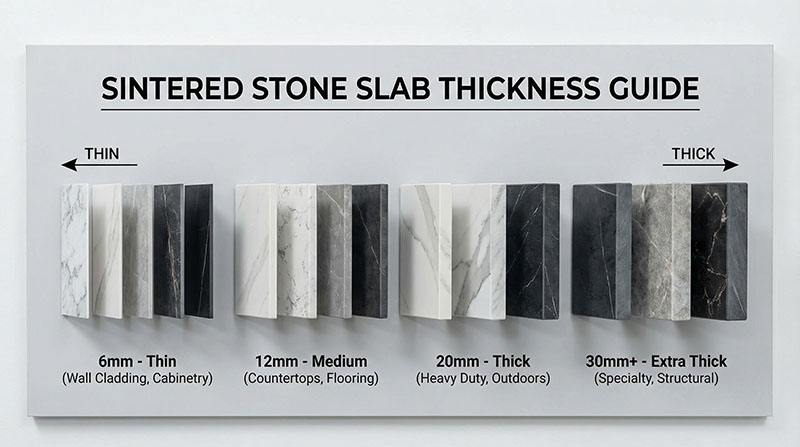
Overview: 6mm vs 12mm vs 20mm Sintered Stone Slabs
Before examining each option in detail, it helps to understand their typical roles:
6mm slabs are optimized for vertical applications and lightweight design solutions.
12mm slabs are the most versatile and commonly specified thickness for countertops and high-use surfaces.
20mm slabs are used when visual mass, additional rigidity, or structural confidence is required.
Each thickness serves a purpose. Problems arise when one thickness is used outside its optimal application range.
6mm Sintered Stone Slabs: Lightweight and Vertical Applications
Typical Applications
6mm sintered stone slabs are most commonly used for:
Interior wall cladding
Decorative feature walls
Furniture panels and cabinetry surfaces
Elevator interiors and retail fit-outs
Advantages of 6mm Thickness
The primary advantage of 6mm slabs is reduced weight. This makes them easier to handle, transport, and install on vertical substrates. Lighter weight also places less stress on wall structures, which is particularly important in renovation projects.
From a design perspective, thinner slabs allow for sleek, modern aesthetics and seamless surface coverage without heavy visual mass.
Limitations and Considerations
Despite their advantages, 6mm slabs are not suitable for all uses. They:
Require full substrate support
Are more sensitive to impact if unsupported
Offer limited edge profiling options
6mm slabs should not be specified for unsupported horizontal applications such as kitchen countertops or islands unless additional reinforcement systems are engineered.
When 6mm Is the Right Choice
6mm sintered stone slabs perform best when used vertically, fully bonded to stable substrates, and when design priorities emphasize weight reduction and clean surface continuity.
12mm Sintered Stone Slabs: The Most Versatile Specification
Why 12mm Is the Industry Standard
12mm sintered stone slabs represent the most widely specified thickness across residential and commercial projects. This thickness offers a balance between strength, workability, and design flexibility.
For many architects and buyers, 12mm is the default choice because it performs reliably across a wide range of applications without excessive structural reinforcement.
Countertops and Work Surfaces
12mm slabs are particularly well suited for kitchen countertops, islands, and commercial work surfaces. Their rigidity supports overhangs, cutouts, and edge detailing while maintaining long-term stability.
Heat resistance, low porosity, and mechanical strength make 12mm slabs ideal for food preparation environments.
Fabrication and Design Flexibility
Compared to thinner slabs, 12mm material allows for:
More robust edge profiles
Cleaner miters and joints
Reduced risk during fabrication
This flexibility simplifies coordination between designers, fabricators, and installers.
Commercial and Residential Use
12mm sintered stone slabs are commonly specified for:
Residential kitchens
Hospitality projects
Retail counters
Office pantries and shared spaces
Their adaptability makes them the safest choice when project conditions vary.
20mm Sintered Stone Slabs: Added Mass and Visual Presence
When Thicker Slabs Are Considered
20mm sintered stone slabs are typically selected when a project requires:
Increased visual weight
Enhanced rigidity for large spans
Premium or monolithic design intent
These slabs are less common than 12mm but serve specific design and structural roles.
Advantages of 20mm Thickness
The additional thickness provides greater stiffness, which can be beneficial for:
Long countertop spans
Heavily trafficked commercial surfaces
Designs emphasizing solidity and permanence
Trade-Offs and Practical Limitations
However, thicker slabs also introduce challenges:
Higher material cost
Increased weight during transport and installation
Limited availability in very large formats
In many cases, similar visual effects can be achieved by laminated or mitered 12mm slabs, offering comparable aesthetics with greater flexibility.
When 20mm Makes Sense
20mm slabs are best specified when structural confidence or design intent clearly justifies the added thickness and cost.
How Thickness Affects Fabrication and Installation
Thickness has a direct impact on fabrication methods and installation requirements.
Edge Detailing
Thicker slabs allow for deeper edge profiles and more pronounced detailing. Thinner slabs often require simpler edge treatments or laminated solutions to achieve similar visual results.
Substrate and Support Requirements
6mm slabs require continuous substrate support
12mm slabs allow for moderate overhangs with proper engineering
20mm slabs offer the greatest rigidity but demand stronger support systems
Handling and Transport
As thickness increases, so does weight. Proper handling equipment and experienced installers become increasingly important to reduce breakage risk.
Thickness Selection by Application Type
Interior Walls and Cladding
6mm slabs are generally sufficient for interior walls when properly bonded. Thicker slabs may be used for design emphasis but are rarely required for performance reasons.
Kitchen Countertops and Islands
12mm slabs provide the best balance of strength, workability, and design flexibility for most countertop applications.
Bathroom Vanities and Wet Areas
Both 6mm and 12mm slabs can be used depending on support conditions and design intent. Water resistance is not thickness-dependent, but rigidity is.
Commercial and Public Spaces
High-traffic environments often benefit from 12mm or thicker slabs due to increased mechanical demands and longer service life expectations.
Large-Format Designs
As slab size increases, thickness selection becomes more critical. Larger formats place greater stress on thinner materials, making 12mm a safer specification choice for expansive surfaces.
Common Specification Mistakes to Avoid
Selecting thickness based on appearance alone
Ignoring slab size and span requirements
Underestimating fabrication and installation constraints
Assuming all manufacturers offer equivalent performance at the same thickness
Avoiding these mistakes reduces project risk and unexpected costs.
How to Choose the Right Thickness for Your Project
When evaluating sintered stone slab thickness, specifiers should consider:
Application type (vertical vs horizontal)
Slab size and layout
Structural support conditions
Fabrication capabilities
Design intent and budget
Understanding these factors enables informed decisions and smoother project execution.
Conclusion: Thickness as a Performance Decision
Sintered stone slab thickness is not a cosmetic choice—it is a performance decision that influences every stage of a project, from design and fabrication to installation and long-term use.
By understanding the differences between 6mm, 12mm, and 20mm slabs, architects and buyers can specify materials that align with real-world conditions rather than assumptions.
Correct thickness selection reduces risk, controls cost, and ensures that sintered stone surfaces deliver the durability and reliability they are designed to provide.