
Sintered Stone vs Quartz: The Real Long-Term Maintenance Cost (What Most Buyers Miss)
Introduction: The Cost Isn’t What You Think
When comparing sintered stone vs quartz, most buyers focus on the upfront price. It’s a natural instinct—material cost per square foot is easy to compare, easy to justify, and easy to present to stakeholders.
But in practice, that number rarely tells the full story.
Over the lifespan of a project, the real cost of a surface material is shaped less by what you pay initially and more by how it performs over time—how it handles heat, wear, cleaning, repairs, and the unexpected issues that inevitably arise in real-world environments.
Quartz is often positioned as the “safe” and predictable choice. Sintered stone, on the other hand, is marketed as a premium, high-performance alternative. Both claims have merit. But neither fully explains what happens after installation, when maintenance, usage patterns, and environmental factors begin to influence cost.
To make an informed decision, it’s worth looking beyond the surface and asking a more practical question:
Which material actually costs less to live with over the next 5 to 10 years?
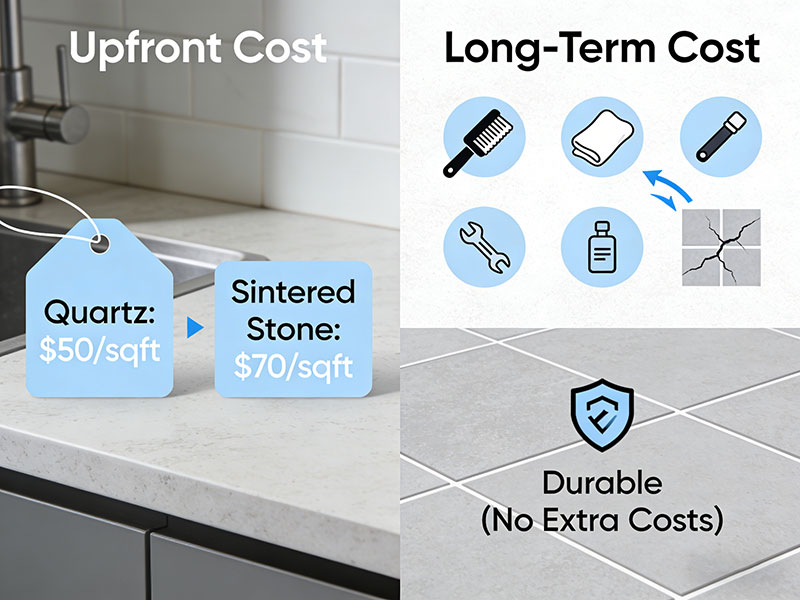
Why Upfront Price Can Be Misleading
Quartz typically comes in at a lower or mid-range price point compared to sintered stone, depending on brand and specification. For many projects, especially those with tight budgets, that makes it an attractive option.
However, focusing solely on initial cost assumes that both materials behave similarly over time. In reality, they do not.
Sintered stone is manufactured through extreme heat and pressure, resulting in a dense, mineral-based surface with minimal organic content. Quartz, while often grouped with stone materials, is actually a composite that includes natural quartz particles bound together with resins.
This distinction becomes important over time, particularly under conditions involving heat, UV exposure, and chemical contact. What looks like a small price difference at the beginning can evolve into a larger cost gap depending on how the material is used.
Daily Maintenance: Similar on Paper, Different in Practice
Both sintered stone and quartz are generally described as “low-maintenance,” and in controlled environments, that description is accurate. Routine cleaning typically requires nothing more than mild detergent and water.
Where the difference begins to emerge is in how each material responds to repeated exposure over time.
Sintered stone’s near-zero porosity means it resists staining even when exposed to substances like wine, coffee, or oils. It does not require sealing, and its surface remains stable under most household or commercial cleaning conditions.
Quartz is also non-porous, but its resin content introduces certain sensitivities. Prolonged exposure to harsh cleaning agents or certain chemicals can gradually affect the surface finish. In most residential settings, this is manageable. In more demanding environments, such as commercial kitchens or high-use spaces, the impact becomes more noticeable.
The difference is subtle at first, but over time, it contributes to maintenance effort and, in some cases, surface degradation.
Heat Exposure: The Hidden Cost Driver
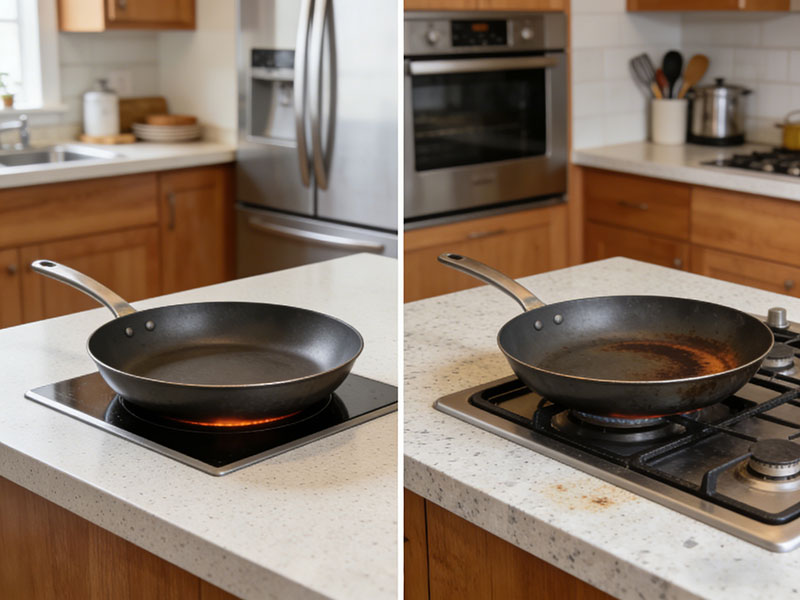
One of the most overlooked factors in long-term maintenance cost is heat.
Sintered stone is designed to withstand high temperatures, often exceeding 300°C, without structural or visual damage. This makes it particularly resilient in environments where direct heat exposure is common.
Quartz behaves differently. Because it contains polymer resins, it is more sensitive to high temperatures. Direct contact with hot cookware or sustained heat exposure can lead to discoloration, surface damage, or, in some cases, structural stress.
This does not mean quartz is unsuitable for kitchens—it is widely used and performs well under normal conditions. However, it does introduce a level of caution that is not always accounted for in cost calculations.
Over time, even minor incidents can lead to repairs or replacements, which are rarely factored into the initial decision.
Repair and Replacement: Where Costs Escalate
No material is immune to damage. The real difference lies in how that damage is handled.
Sintered stone is highly resistant to scratching, heat, and UV exposure, which reduces the likelihood of visible wear. However, if damage does occur—such as a crack caused by improper installation or impact—it can be more challenging to repair due to the material’s density.
Quartz, being slightly more forgiving in fabrication, can sometimes be easier to repair in localized areas. At the same time, it is more susceptible to certain types of damage, particularly heat-related issues or surface wear over time.
In both cases, replacement is often more practical than repair for major damage. This is where lifecycle cost becomes important. A material that experiences fewer issues over time, even if more difficult to repair, may still result in lower overall cost.
UV Exposure and Aging
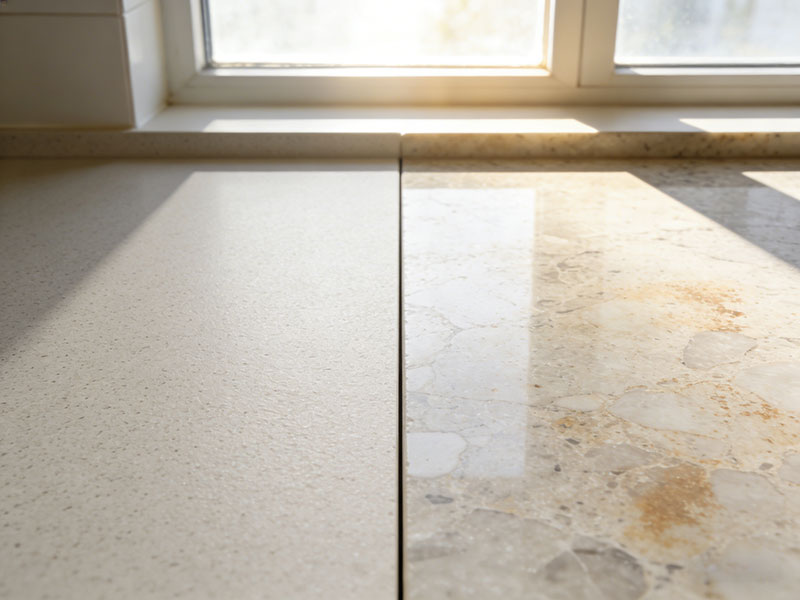
For projects involving natural light or outdoor applications, UV exposure becomes a critical factor.
Sintered stone is inherently UV stable, meaning it maintains its color and structural integrity even under prolonged sunlight exposure. This makes it suitable for both interior and exterior use without concern for fading.
Quartz, by contrast, is generally recommended for indoor use. Extended exposure to UV light can lead to discoloration over time due to the presence of resins. While this may not be an immediate issue, it can become a concern in projects with significant sunlight exposure.
From a long-term perspective, this limitation can influence both maintenance decisions and replacement cycles.
The Real Lifecycle Cost Comparison
When viewed over a 5–10 year period, the cost difference between sintered stone and quartz becomes less about initial price and more about performance consistency.
Sintered stone tends to maintain its original condition with minimal intervention. Its resistance to heat, UV exposure, and staining reduces the likelihood of unexpected costs.
Quartz, while cost-effective upfront, may require more careful use and, in some cases, earlier replacement depending on environmental conditions and usage patterns.
This does not mean quartz is the more expensive option in every scenario. In controlled residential environments with moderate use, it often performs efficiently and delivers good value.
However, in high-use or demanding settings, the balance can shift.
When Quartz Is Still the Right Choice
Despite these considerations, quartz remains a highly practical material for many projects.
It offers consistent appearance, ease of fabrication, and widespread availability. For indoor residential applications where heat exposure is limited and usage is predictable, quartz can provide an excellent balance between cost and performance.
In these cases, its lower upfront cost may align well with project requirements, particularly when long-term stress factors are minimal.
When Sintered Stone Becomes the Better Investment
Sintered stone begins to show clear advantages in environments where durability and resistance are critical.
Projects involving high heat, heavy usage, or outdoor exposure benefit from its stability and low maintenance requirements. Over time, these characteristics can offset the higher initial cost by reducing the need for repairs, replacements, or additional care.
For commercial spaces, hospitality environments, and premium residential projects, this reliability often translates into better long-term value.
A More Practical Way to Decide
Rather than asking which material is better in general, it is more useful to consider how each material aligns with the specific conditions of your project.
If the environment is controlled, usage is moderate, and budget is a primary concern, quartz remains a strong and practical option.
If the project involves higher stress, exposure, or long-term performance expectations, sintered stone offers a level of durability that can justify its cost.
In many cases, the most cost-effective decision is not the cheapest material, but the one that performs most consistently over time.
Final Thoughts
The comparison between sintered stone vs quartz is not simply a matter of price or popularity. It is a question of how materials behave beyond the showroom, under real conditions that introduce wear, stress, and variability.
Both materials have their place. The key is understanding their limitations as well as their strengths.
For buyers and decision-makers, this perspective shifts the conversation from short-term savings to long-term value—a shift that often leads to better outcomes.
If you are evaluating surface materials for a project, it can be useful to review not only product specifications but also real-world performance factors such as heat exposure, usage patterns, and installation conditions.
Working with suppliers who can provide technical guidance and application-specific recommendations can help reduce uncertainty and ensure that the selected material performs as expected over time.
Contact us to discuss your project requirements and explore the most cost-effective solution based on actual use conditions.