
Large Calacatta Sintered Stone Slabs Are Changing Modern Design
Modern interiors are moving toward surfaces that feel quieter, more continuous, and more architectural. Instead of treating countertops, walls, islands, and vanities as separate decorative elements, designers increasingly use large surface areas to create a unified visual language. This shift has made large-format sintered stone particularly relevant, especially when the material features a distinctive pattern such as Calacatta.
Large Calacatta sintered stone slabs do more than provide a marble-inspired appearance. Their size gives the veining enough room to develop across the surface, while the reduced number of joints helps create the uninterrupted appearance associated with contemporary luxury interiors. When slab selection, layout, fabrication, and installation are considered together, the material can become an important part of the architecture rather than simply a finish applied to it.
Large Slab Dimensions Are Changing the Way Modern Surfaces Are Designed
The influence of large-format surfaces begins with something deceptively simple: scale.
A conventional surface may be divided into several pieces because of standard material dimensions. Each joint creates a visual boundary, and repeated boundaries can make an expansive countertop or wall feel segmented. Large slabs change that relationship by allowing a greater portion of the design to remain visually continuous.
This is particularly effective in contemporary interiors, where clean geometry and restrained material palettes are common. A large kitchen island, for example, can become a single visual plane rather than a collection of smaller sections. A full-height wall can carry one uninterrupted material expression from floor to ceiling. The result is not necessarily more decorative; instead, it is often more cohesive.
Large-format design also gives architects and interior designers greater freedom to work with proportion. The available slab dimensions can influence the size and placement of an island, backsplash, vanity, or feature wall. Rather than designing a surface first and choosing a material afterward, the slab itself can become part of the planning process.
That approach is especially important with patterned materials. With a relatively plain surface, a joint may be visually unobtrusive. With a strongly veined Calacatta design, however, a poorly positioned cut can interrupt a vein at exactly the wrong point and weaken the composition.
Calacatta Veining Becomes More Expressive Across a Large Slab
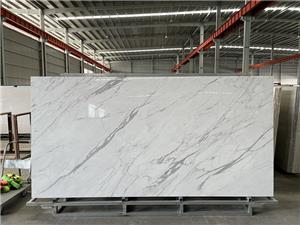
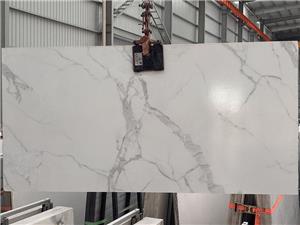
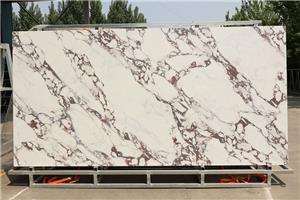
The appeal of Calacatta lies largely in its veining. A white or softly colored background provides a calm foundation, while flowing gray, charcoal, or warmer-toned veins introduce movement and visual depth.
On a small surface, only part of that movement may be visible. A countertop section might capture one fragment of a vein, while another section begins with an unrelated pattern. On a large slab, the eye can follow the vein across a much greater distance.
This changes the role of the material.
Instead of functioning as a repeated decorative pattern, the Calacatta design can behave more like a large-scale composition. A long vein may travel across a kitchen island, while secondary veins create balance around it. On a feature wall, the movement of the pattern can become a deliberate architectural focal point.
Vein scale matters as well. A dramatic Calacatta pattern generally benefits from enough surface area for its major veins to develop naturally. If the same pattern is repeatedly divided into small pieces, the visual character can become less coherent. Large slabs preserve more of the original relationship between the background and the principal veins.
The direction of the veining is equally important. A slab with predominantly horizontal movement can emphasize the length of a countertop or wall. A more vertical pattern may reinforce the height of a feature wall. Diagonal movement can introduce energy into an otherwise geometric space.
For this reason, choosing a Calacatta slab should not be based solely on whether its color looks attractive in a sample. The entire slab deserves attention. Designers need to consider where the major veins will fall after cutting and how they will relate to the surrounding architecture.
Seamless Visual Continuity Creates a Stronger Architectural Effect
One of the most noticeable benefits of large Calacatta sintered stone slabs is the ability to create longer visual fields with fewer joints.
This matters because modern design often relies on continuity. A countertop that flows directly into a backsplash can feel more integrated than one separated by multiple visible seams. A bathroom wall finished with large panels can appear calmer than one divided into numerous smaller pieces. A fireplace surround can become a single sculptural element when the material pattern remains visually connected.
The effect becomes even more pronounced when horizontal and vertical surfaces meet.
Consider a kitchen island with a waterfall edge. If the Calacatta veining is carefully positioned, the pattern can move from the horizontal countertop toward the vertical side, creating a sense that the entire island has been formed from one continuous piece of stone. The edge is still physically fabricated, but the visual transition is much more deliberate.
The same principle applies to full-height backsplashes. Extending a large slab upward from the countertop can eliminate the visual interruption created by numerous smaller tiles or panels. The result allows the Calacatta pattern to remain the dominant visual feature without competing with excessive grout or joint lines.
Of course, large slabs do not eliminate every seam. Physical dimensions, structural requirements, access limitations, and fabrication constraints still determine how surfaces must be divided. The goal is not to promise a completely joint-free installation. It is to use the available slab dimensions intelligently so that necessary joints have as little negative impact on the overall composition as possible.
Large Calacatta Slabs Transform Key Interior Applications
The strongest applications are those where a broad surface can actually showcase the scale and movement of the Calacatta pattern.
Kitchen Islands and Waterfall Countertops
Kitchen islands are one of the clearest examples. Their large horizontal surfaces provide enough room for a substantial calacatta pattern to become visible, while the island itself often serves as the visual center of an open-plan kitchen.
Large slabs also provide greater flexibility when designing waterfall edges. Instead of treating the edge as an unrelated vertical panel, fabricators can plan the cut so the veining has a deliberate relationship with the top surface.
This requires careful slab orientation and cutting. The most visually attractive result is rarely achieved by simply cutting the required dimensions from whichever portion of the slab is most convenient. The vein composition should be considered before fabrication begins.
Full-Height Backsplashes and Feature Walls
Walls offer another opportunity to use Calacatta sintered stone as architecture rather than decoration.
A full-height backsplash can create a strong connection between a kitchen countertop and the surrounding cabinetry. In a neutral kitchen, the large slab can provide the principal source of movement without overwhelming the room with multiple materials.
Feature walls take this idea even further. In a living room, hotel lobby, reception area, or retail environment, a large Calacatta slab can act almost like a piece of artwork. Its scale allows the main veins to remain visible from a distance, giving the wall a sense of depth that smaller pieces may not achieve.
Luxury Bathrooms
Bathrooms benefit from large-format surfaces because the material can continue across substantial vertical areas. Walls, shower surrounds, and vanity surfaces can share a consistent Calacatta appearance, reducing the fragmented effect of numerous small-format finishes.
This approach works particularly well in contemporary bathrooms where designers want the room to feel spacious and restrained. Instead of relying on many decorative elements, the movement within the slab provides visual interest.
Hospitality and Commercial Interiors
The same characteristics make large Calacatta sintered stone suitable for statement areas in hotels, restaurants, retail spaces, and other commercial interiors.
A reception desk, feature wall, bar counter, or prominent architectural surface can use the material to establish a recognizable visual identity. In these settings, the slab is often viewed from greater distances, making scale especially important.
For commercial projects, however, appearance is only part of the specification. Production capacity, technical documentation, packaging, transportation, fabrication support, and consistency across multiple slabs can have just as much influence on the final result.
Slab Selection and Vein Layout Shape the Final Design
A successful large-format installation begins well before the slab reaches the fabrication shop.
For Calacatta designs, slab selection should be connected to the actual project layout. A supplier may provide several slabs from the same collection, but those slabs may not have identical vein movement. When a project requires multiple slabs, selecting them as a coordinated group can help maintain a consistent visual direction.
The designer and fabricator should also determine which areas of the slab will become the most visible surfaces. A major vein crossing directly through a sink cutout, cooktop opening, or plumbing penetration may disappear from the composition. In another location, that same vein could become the defining feature of the finished surface.
This is where digital slab layouts and fabrication drawings become valuable. By positioning the actual countertop, wall panel, or furniture components over the slab image before cutting, the team can see how the finished pattern is likely to develop.
Bookmatching can also be considered when the design calls for symmetrical or mirrored movement. It is not appropriate for every Calacatta pattern, but when the vein structure supports it, carefully matched slabs can create a dramatic architectural effect.
The important principle is simple: the slab pattern should be planned around the architecture, not treated as an afterthought once the dimensions have already been finalized.
Fabrication and Installation Require Early Planning for Large Slabs
The visual advantages of large-format slabs come with greater coordination requirements.
A large slab must first reach the project site safely. Doorways, corridors, elevators, stairs, loading areas, and installation zones all need to be considered before production is finalized. A slab that fits the design perfectly on paper may still present a logistical problem if the finished piece cannot be moved into position.
Fabrication also requires precision. Large countertops and wall panels have less room for dimensional errors, particularly when they need to align with cabinetry, appliances, architectural openings, or adjacent panels.
Handling is another important consideration. Large-format sintered stone should be moved and installed using appropriate equipment and procedures suited to its dimensions and thickness. Experienced fabricators can account for these requirements during the planning stage rather than attempting to solve them at installation.
Early coordination also helps reduce unnecessary material waste. When the vein layout is considered alongside cutting requirements, the fabrication team can determine how to position components more effectively while preserving the most important visual features of the slab.
For large commercial projects, this coordination becomes even more important because multiple parties may be involved. The designer, stone fabricator, installer, project manager, and supplier should work from compatible drawings and specifications so that the intended design survives the transition from slab selection to completed installation.
What to Look for in a Large Calacatta Sintered Stone Slab Supplier
Large-format projects place greater demands on a supplier than simply providing attractive slab images.
Manufacturing consistency is one of the first considerations. When several slabs are required for one project, differences in background tone, vein density, surface finish, or overall pattern can become noticeable once the slabs are installed next to one another.
Available dimensions and thicknesses should also match the intended application. A supplier should be able to provide clear technical information rather than relying solely on photographs or general product descriptions.
Quality control is equally important. Large slabs need consistent flatness and surface quality because imperfections can become much more noticeable across expansive areas. Proper inspection before shipment can help identify issues before the material reaches fabrication.
For international projects, packaging and export handling deserve attention as well. Large slabs require secure protection throughout transportation, and reliable documentation can make coordination easier for fabricators and project teams.
A capable Calacatta sintered stone supplier should also be able to discuss slab selection rather than simply quoting a product name. High-resolution slab images, production information, available formats, technical specifications, and project coordination support can all help designers make more informed decisions.
For projects involving substantial quantities, production capacity is another important consideration. The ability to reproduce a design consistently and maintain supply across a project schedule can be just as important as the appearance of an individual slab.
Conclusion
Large Calacatta sintered stone slabs are changing modern design because their impact goes beyond surface size. A larger slab gives Calacatta veining room to develop, reduces visual fragmentation, and allows designers to treat the surface as part of the architecture.
The strongest results come when the material is considered from the beginning of the design process. Slab dimensions, vein direction, cutting layouts, fabrication requirements, transportation, and installation all influence how the finished surface will look.
For architects, designers, fabricators, and project teams, the opportunity is therefore not simply to specify a larger slab. It is to use the slab's scale deliberately—to preserve the movement of the Calacatta pattern, create stronger visual continuity, and turn expansive surfaces into defining elements of contemporary interiors.